
Quality
Quality is a sequence, not a checkpoint.
The KMS quality framework
Six stages, one loop.
01
Define
The quality target product profile and critical quality attributes are set before development starts, informed by patents, literature and compendial requirements.
02
Design
Quality by Design: formulation and process risk assessment, then design of experiments to find robust ranges instead of a single recipe.
03
Verify
Analytical methods are developed and validated. Stability is studied to ICH guidelines in controlled temperature, humidity and photostability chambers.
04
Control
Critical process parameters are identified and a design space established during scale-up, so the process behaves the same at the next site.
05
DocumentV-25
Development, transfer and validation work is documented for regulatory filing, in line with cGMP and cGLP expectations.
06
Improve
OOS and OOT investigations, statistical process control and continual improvement of the quality management system feed back into the next programme.
Quality assurance
Oversight that sits outside the programme.
Quality assurance oversees development, technology transfer and validation, and keeps the quality system aligned with US FDA and other regulators’ expectations rather than with a project timeline.
Quality control
Validated methods, consistently applied.
Quality control works only from validated, accurate analytical methods, so every result that leaves the laboratory can be relied on by the person filing it.
Our partners file the data we generate. That is the standard every method, batch and record here is held to.
Recognition
Recognised systems, accountable people.
- In-house R&D recognised by DSIR, Government of IndiaV-03What it represents: the Department of Scientific and Industrial Research has assessed our facilities, scientists and research activity as a genuine in-house R&D unit. Why it matters: it is an independent check on the laboratory your programme will run in.
- ISO-certified quality management systemV-04What it represents: documented procedures, defined responsibilities and periodic external audit of how we work. Why it matters: the records behind your dossier were produced under a system somebody else inspects.
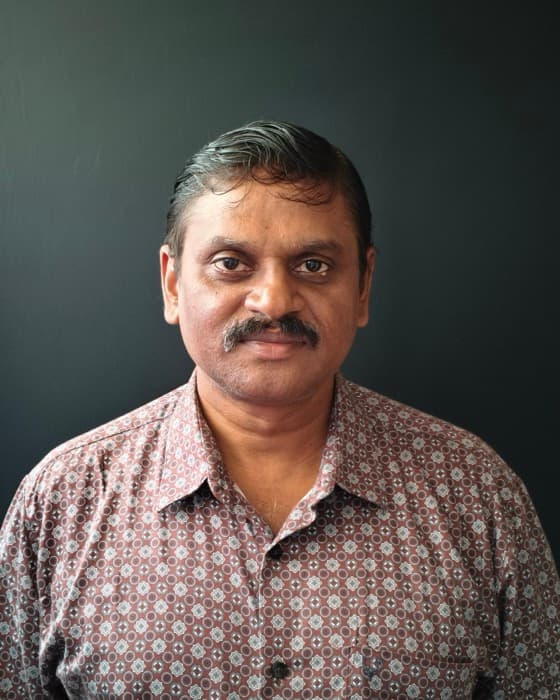
Dr S. John Prasanna
Senior Analytical Consultant
Dr Prasanna brings 25 years in pharmaceutical analytical development across APIs, injectables, CRO operations and regulatory compliance, with senior roles at Orchid Pharma, Syngene International, Strides Shasun Research Centre, Aurobindo Pharma Research Centre and IIT Kanpur. His work spans method development, validation and transfer, stability studies, impurity characterisation and instrument qualification on HPLC, LC-MS, GC-MS, NMR, HRMS, PXRD, DSC and FTIR, with particular depth in impurity profiling, nitrosamine risk assessment and polymorphism. He has supported DMF and ANDA submissions to ICH, US FDA and EMA requirements, has published widely and holds an Indian patent.
Start a conversation
Where does your programme stand?
Tell us the molecule, the dosage form and the market you are filing in. A programme lead will read it and reply with what we would do next.
Business enquiries: vasanthi@kmshc.com · +91 97898 75194V-23